Billions of dollars are being invested into quantum computing, and with terms such as Quantum Supremacy and Quantum Machine Learning expectations have reached meteoric heights. Quantum computing is being portrayed as (or is assumed to be) a new computing technology that will almost magically:
- Disrupt the internet by breaking Cryptography
- Change Artificial Intelligence
- Replace classical computers
My view on this is that quantum computing has the potential to go where no classical computer has gone before. It also the potential change our lives in unimaginable ways. However, it is not going to replace Classical Computing or Artificial Intelligence. Neither is it magical.
Where are the short-term opportunities?
Quantum computing enables substantially faster calculation in some scenarios. It does not offer superior data IO or memory management capabilities. This in the short-term (next 10 years) will likely impact Quantum Chemistry (simulation of quantum physical processes from chemistry and solid state physics) which could lead to significant advances in Chemistry, Material Sciences, Manufacturing, Batteries, Pharmaceutical Compounds, Personalized Medicine, etc.
In-addition quantum computers will be able to perform many other specialized optimization tasks.
Note: Subsequent sections provide a high level explanation that support the conclusions reached in this article.
What is not likely in the next 10 years?
Don’t expect quantum computers to break RSA 2048 anytime soon. This requires at a minimum 2048 qubits, and as number of qubits increases so does noise and error rate. Compensating for errors (or error control) would require 10 to 1000 times the qubits (i.e. 20, 480 to 2,048,000 qubits to crack RSA 2048). The current state of the art is 70 qubits, and this may never be possible using quantum computers. Furthermore, organization can simply switch to RSA 4096.
The state of the art (SOTA) in AI/ML uses millions of neural network. An entire neural network can’t be simulated using a quantum computer (although a quantum computer may be able to complement and enhance AI/ML hardware and software).
Replacement classical computers is impossible for many reasons explained below.
Classical vs. Quantum: A quick comparison
| Comparison | Classical Computer | Quantum Computer |
| Environment | 0.015 Kelvin Shield from vibrations | Room temperature |
| Continuous Operation | Indefinitely | 50 qubit for 90 microseconds |
| Clock Speed | GHz | 100s of MHz |
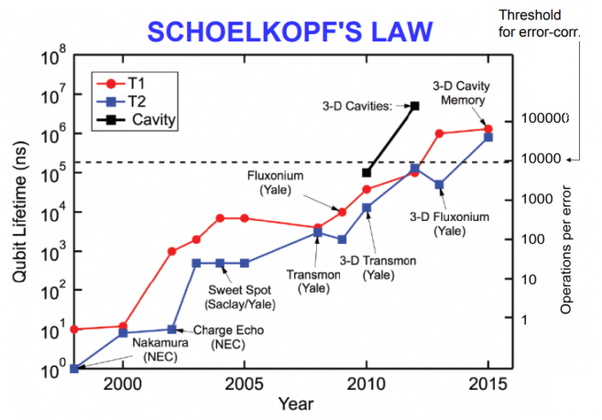
To summarize a quantum computer can only run in special server rooms and be offered as a private or public cloud service. Further, they are very expensive and only make sense when solving certain mathematically problems that require significant computation. Solving a problem within a qubit lifetime is an additional constraint.
Why Quantum Computing is not a magical solution?
Classical computer programs or even algorithms can’t be ported to quantum computers. New mathematical algorithms that take advantage of quantum computing have to be developed from scratch, and these algorithms are problem specific. The following video illustrates the work involved in developing an algorithm that can factor RSA semiprimes.
Essentially lots of new mathematical algorithms and software applications have to be developed following the development quantum computing hardware.
Quantum Supremacy
This term specifically refers to a point where classical computers (including super computers) will be unable to simulate supercomputers. However, is important to note that this does not imply that quantum computers will be able to outperform classical computers at all tasks (or many tasks). Futurmore, quantum supremacy does not demonstrate a single viable use case.
Conclusion
- Quantum computing’s killer apps are Quantum Chemistry and Business Optimization problems
- It is unlikely to crack RSA 2048, replace current AI/ML approaches and classical computers
- Combining quantum computing with classical computing and/or use of quantum chemistry to enhance classical computing may have a compounding effect on the field of computing.
Reference
- One of the better videos I have seen on quantum computing – https://youtu.be/yy6TV9Dntlw
- A high level overview on the mathematics behind quantum computing – https://youtu.be/IrbJYsep45E
- Forecasts for applying quantum computing in quantum chemistry, machine learning and cracking RSA 2048 – https://quantumcomputingreport.com/our-take/applying-moores-law-to-quantum-qubits/
 My Views - Application of AI & Programming