In a report by PwC (link to provided at the end of this post), the company stated “AI could contribute up to $15.7 trillion to the global economy in 2030, more than the current output of China and India combined”. The report also states “According to our analysis, global GDP will be up to 14% higher in 2030 as a result of the accelerating development and take-up of AI”.
The report also further states
- “$6.6 trillion is likely to come from increased productivity”
- “$9.1 trillion is likely to come from consumption side effects”
Another report by MarketsandMarkets™ states that the “Next Wave of Artificial Intelligence Market Worth $190B by 2025”.
There is a general expectation that AI will grow exponentially and have a significant impact on the global economy over the coming years.
Context / Caveats
It is important to note that the comparison to China and India’s economies is based on 2016 figures, as per the following note included in the PwC report.
- “$ denotes US dollars throughout, estimated values are expressed in real terms at 2016 prices (i.e. excluding the impact of general price inflation when looking ahead to 2030)”
The economies of China and India combined exceeded $20T in 2022. Also, it is important to note that PwC states “up to $15.7T”.
Viewpoint
It is extremely difficult, if not impossible, to accurately predict the economic impact of a technology that is improving exponentially. This is especially true when it comes to artificial intelligence (AI), which has the potential to transform virtually every industry and reshape the global economy.
While AI continues to advance rapidly, it is unlikely that we will see the development of artificial general intelligence (AGI) or fully autonomous vehicles (Level 5) by 2030. These technologies require a level of AI sophistication that may not be achievable in the next decade. However, it is possible that we may see significant progress in these areas, and it is impossible to be certain that AGI or Level 5 fully autonomous vehicles will not be developed by 2030.
In addition to the advancements in AI, the internet, mobility, and augmented and virtual reality technologies will also continue to evolve. The compounding effect of combining all of these technologies is even harder to predict, as it has the potential to create new economic opportunities and disrupt existing industries in ways that we cannot even imagine today.
Overall, while it is difficult to predict the economic impact of exponentially improving technologies, it is clear that they will have a significant impact on the global economy in the coming years.
Use Cases
The PwC report identifies many interesting use cases grouped by vertical markets (sectors). There are some use cases that I am particularly excited about (some covered in PwC report others are not) that are presented below. They are either grouped into horizontal solutions or into vertical markets.
Marketing & Sales
50% to 75% of traditional marketing efforts are wasted. By 2030 AI would help Marketers and Sales Professionals create content 5X to 10X faster. AI would also help optimize Marketing & Sales increase productivity and add trillions to the global market.
Customer Support
By 2030 AI would help author majority of the Customer Support content. Chatbots will substantially reduce the need for Customer Support Staff but will eliminate the need.
Media and Entertainment
AI will be used to generate and edit characters and backgrounds for games, movies and TV shows. AI will also be used to manage the gaming experience.
Consumer Products
Many consumer products such as Smartphones, Computers, Cars, Household Appliances, etc. already incorporate Artificial Intelligence. AI technologies incorporated include GPS & Navigation, Computer Vision (detect faces, forms, etc.), Speech Recognition, Natural Language Processing, and Speech Synthesis (TTS). More of these appliances will incorporate AI, and existing products will add more AI or enhance existing capabilities.
Semiconductors and Technology
More and more computer chips will be optimized using AI and some of these chips will be optimized for AI. This in turn will improve AI.
Many more non-consumer-facing applications and systems will also incorporate AI.
Manufacturing
AI for manufacturing quality control and logistics will contribute to manufacturing growth. However, some of the biggest breakthroughs in manufacturing will likely happen as a result of AI-driven improvements in material sciences, additive manufacturing (3D printing) and nanotechnologies.
I am assuming many of these biggest breakthroughs and growth in this space will happen after 2030.
Healthcare, Pharma and Medical Devices
Healthcare has been slow to adopt IT and will likely be slow to adopt AI. However, breakthroughs in the analysis and prediction of protein folding and medical imaging demonstrate huge potential.
Still, I am assuming significant changes to healthcare will take longer due to the conservative nature of healthcare and the lengthy and costly clinical trial process.
Conclusion
There is no doubt that artificial intelligence (AI) will have a significant impact on the global economy in the coming years. It is already being used in a variety of industries, including manufacturing, healthcare, and finance, to increase productivity and efficiency. As AI continues to evolve, its capabilities will expand, enabling it to take on more complex tasks and even replace certain jobs.
According to a report by PwC, AI could contribute up to $15.7 trillion to the global economy by 2030. This value will be generated through a combination of increased productivity, cost savings, and the development of new products and services.
Initially, AI will add value by automating tasks and assisting humans in their work. This will lead to increased productivity as AI can work around the clock without the need for breaks or vacations. In the next phase, AI will augment human intelligence by working alongside humans and providing guidance and recommendations. This is known as human-in-the-loop (HITL) and will enable humans to make more informed decisions and take on more complex tasks.
It will take longer for AI to achieve autonomous intelligence, where it can operate and make decisions on its own. However, when this happens, it has the potential to revolutionize entire industries and create new economic opportunities that we cannot even imagine today.
Overall, the impact of AI on the global economy will be multi-trillion-dollar by 2030, with the potential to transform the way we live and work.
References
- PwC report
2. Nominal GDP by Country – Source Wikipedia
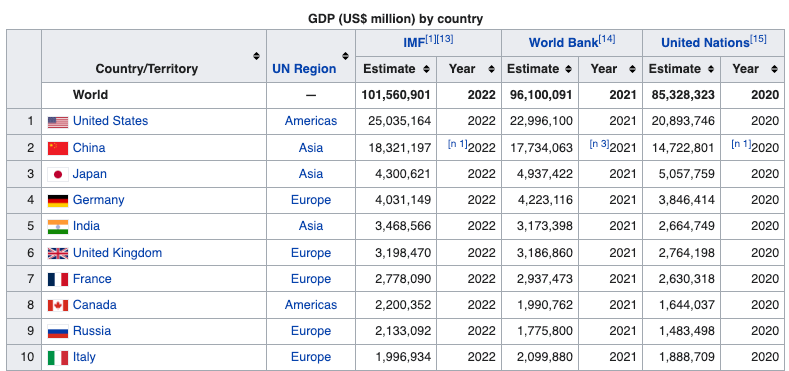
3. GDP (PPP) by Country – Source Wikipedia

 My Views - Application of AI & Programming